 English

Search
SGP interlayer outperforms PVB in structural strength, stiffness, and moisture resistance, making it the preferred choice for high-performance architectural and safety glazing. PVB interlayer film, however, remains the industry standard for most laminated glass applications due to its excellent optical clarity, sound insulation, and cost efficiency.
The better option depends on whether your project prioritizes structural performance or cost-effective, versatile glazing.
PVB interlayer film (polyvinyl butyral) is the most widely used interlayer material in laminated glass. It bonds glass layers together to improve safety, acoustic performance, and UV resistance.
A typical glass PVB interlayer structure consists of:
Glass / pvb interlayer / Glass
This configuration ensures that when glass breaks, fragments remain adhered to the interlayer, reducing injury risk.
Excellent adhesion to glass
High optical clarity
Strong sound insulation performance
Good UV blocking capability
Flexible and easy to process
As a leading pvb film manufacturer would emphasize, PVB remains the default choice for architectural, automotive, and decorative laminated glass.
SGP (SentryGlas® Plus) is an ionoplast interlayer known for its exceptional stiffness and strength.
Compared to film pvb, SGP offers:
Significantly higher tensile strength
Greater stiffness (less deflection under load)
Superior resistance to moisture and edge exposure
Enhanced post-breakage structural integrity
SGP is commonly used in applications where laminated glass must perform as a structural element.
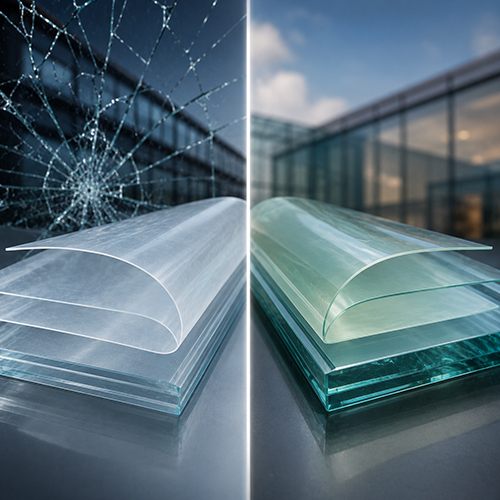

This is the most critical difference.
SGP interlayer:
Up to 5 times stronger than PVB
Up to 100 times stiffer
Suitable for structural glazing
PVB interlayer film:
Flexible and less stiff
Not designed for load-bearing applications
For projects such as glass floors, facades, or balustrades, SGP is often required.
SGP:
Holds glass fragments firmly in place
Maintains structural integrity even after breakage
PVB:
Holds fragments but allows more deformation
In safety-critical applications, SGP provides higher residual strength.
SGP interlayer:
Excellent resistance to moisture
Minimal edge clouding or delamination
PVB film for laminated glass:
Sensitive to moisture over time
Requires proper edge sealing
For exposed or humid environments, SGP performs better.
Both materials offer high transparency, but there are subtle differences:
PVB interlayer film:
Excellent clarity
Available in various colors and acoustic grades
SGP:
High clarity but fewer customization options
PVB is often preferred for decorative or acoustic laminated glass.
PVB interlayer:
Superior sound damping properties
Widely used in acoustic glass
SGP:
Lower acoustic performance compared to PVB
For noise reduction, glass PVB interlayer solutions are more effective.
PVB film manufacturer advantages:
Mature production technology
Lower material cost
Easier lamination process
SGP:
Higher material cost
More demanding processing conditions
PVB remains the more economical choice for large-scale projects.
Both materials are “better” in different contexts.
Cost-effective laminated glass
Acoustic insulation
Decorative or colored glass
Standard architectural or automotive applications
Structural load-bearing performance
High safety and impact resistance
Outdoor durability and moisture resistance
Minimal deflection in large glass panels
Yes, SGP is significantly stronger and stiffer than PVB.
This makes SGP suitable for:
Hurricane-resistant glazing
Blast-resistant systems
Structural glass assemblies
However, strength is not always necessary for every application, which is why pvb film for laminated glass remains widely used.
Despite SGP’s advantages, PVB continues to dominate the market.
Reasons include:
Lower cost
Proven long-term performance
Versatility in different applications
Availability from multiple pvb film manufacturers
Better acoustic insulation
For most standard laminated glass applications, PVB provides the optimal balance of performance and cost.
In most cases, no.
PVB lacks the stiffness required for structural glazing. Using film pvb in such applications may result in:
Excessive deflection
Reduced load-bearing capacity
Potential safety risks
For structural or exposed-edge designs, SGP is typically required.
Automotive windshields
Architectural laminated glass
Acoustic glass systems
Decorative glass panels
Glass facades and curtain walls
Glass floors and stairs
Balustrades and railings
High-security glazing
The decision should be based on performance requirements rather than material preference.
Load-bearing requirements
Environmental exposure (humidity, UV)
Acoustic performance needs
Budget constraints
Design complexity
In many projects, a glass PVB interlayer solution is sufficient. For advanced structural designs, SGP becomes essential.
The industry is increasingly adopting hybrid approaches:
Using PVB for standard layers
Using SGP selectively in high-stress areas
This allows manufacturers to balance cost and performance effectively.
SGP interlayer is the superior choice for structural strength, durability, and demanding environments, while PVB interlayer film remains the most practical and widely used solution for general laminated glass applications.
For most projects, pvb interlayer film offers the best balance of performance, cost, and versatility. For high-performance or structural glazing, SGP provides capabilities that PVB cannot match.
Selecting the right interlayer ultimately depends on your project’s technical requirements and long-term performance expectations.
PVB is flexible and cost-effective, while SGP is stronger, stiffer, and more suitable for structural applications.
Yes, but proper edge sealing is required to prevent moisture-related issues.
SGP offers significantly higher mechanical performance and durability, which increases material and processing costs.
Yes, it is widely used in safety glass, especially in automotive and architectural applications.
PVB interlayer provides better acoustic performance compared to SGP.