 English


Search
Hot melt lamination is the preferred process for TPU lamination film in most high-performance applications because it delivers superior bonding strength, optical clarity, and long-term durability. Adhesive lamination is still used in certain niche or cost-sensitive scenarios, but it introduces additional variables such as adhesive compatibility, aging risks, and reduced structural integrity.
For manufacturers working with TPU interlayer materials, selecting the right lamination process directly impacts product quality, production efficiency, and long-term performance.
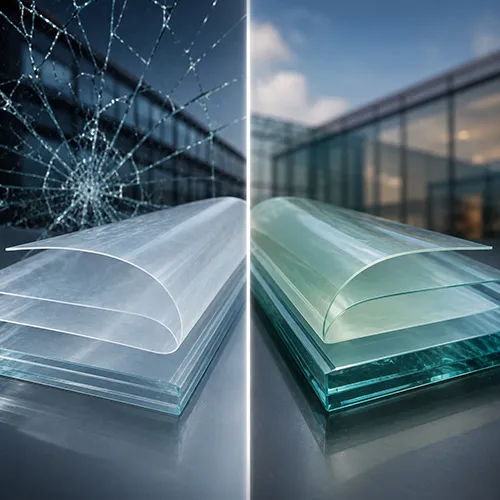
TPU film lamination refers to the process of bonding a TPU lamination film between substrates such as glass, polycarbonate, or metal using heat, pressure, or adhesive systems.
In industrial production, a TPU film laminate structure is typically formed through:
Thermal bonding (hot melt lamination)
Chemical bonding (adhesive lamination)
The process you choose will determine the final performance of the TPU laminate, especially in terms of adhesion, transparency, and durability.
| Aspect | Hot Melt Lamination | Adhesive Lamination |
Bonding Mechanism | Thermal fusion of TPU | External adhesive layer |
Adhesion Strength | Very high | Medium to high (depends on adhesive) |
Optical Clarity | Excellent (no intermediate layer) | May be affected by adhesive layer |
Process Complexity | Requires precise temperature and pressure control | Easier but adhesive-dependent |
Durability | Excellent (no chemical degradation layer) | Adhesive aging risk |
Application | Safety glass, automotive, high-end laminates | Decorative panels, flexible composites |
Hot melt lamination relies on the thermoplastic properties of TPU.
Pre-assembly
Layers (glass/TPU/glass or substrate/TPU/substrate) are stacked
Heating stage
TPU softens and becomes viscous under controlled temperature
Pressure and vacuum (if required)
Air is removed and pressure ensures full surface contact
Cooling and solidification
TPU re-solidifies, forming a strong, permanent bond
TPU naturally melts and flows, eliminating the need for additional adhesives
Creates molecular-level bonding between surfaces
Minimizes the risk of delamination caused by adhesive incompatibility
For TPU film lamination, this method ensures maximum performance in safety-critical applications such as laminated glass and automotive glazing.
Adhesive lamination introduces a third material—an adhesive—between the TPU film and the substrate.
Apply adhesive coating to substrate or TPU
Combine layers under pressure
Cure adhesive (heat or UV depending on type)
While easier to implement, adhesive lamination introduces several challenges:
Weaker interface: bonding depends on adhesive rather than TPU
Aging issues: adhesives can degrade over time due to UV and moisture exposure
Optical impact: adhesive layers may reduce clarity
Compatibility concerns: TPU, adhesive, and substrate must be chemically compatible
For high-performance TPU laminate products, these limitations can be critical.
Hot melt lamination consistently provides stronger and more reliable adhesion.
Because the TPU interlayer itself acts as the bonding medium, the interface is:
Continuous with no foreign layer
Stable under temperature fluctuations
Resistant to moisture and environmental exposure
Adhesive lamination depends heavily on the stability and quality of the adhesive system, which can vary.
Not always—but it is strongly recommended for performance-driven applications.
Laminated safety glass
Automotive glazing
Impact-resistant or security panels
Structural composite materials
Decorative laminates
Flexible materials or textiles
Low-load or non-structural applications
Optical clarity is a key performance indicator in TPU film laminate applications.
Hot melt lamination:
No intermediate layer
Uniform optical properties
High transparency
Adhesive lamination:
Risk of haze or bubbles
Potential uneven coating
Long-term yellowing
For industries such as architecture and automotive, hot melt lamination is typically preferred.
In hot melt TPU film lamination, process control is essential.
Temperature range (typically 110–140°C depending on TPU grade)
Pressure level (to ensure full contact without distortion)
Lamination time
Vacuum conditions (to eliminate air bubbles)
Improper processing can result in:
Incomplete bonding
Air entrapment
Optical defects
Adhesive lamination adds further complexity, as curing conditions must also be tightly controlled.
Yes, depending on the application and equipment.
Common alternatives include:
Vacuum laminators
Roll-to-roll lamination systems
Flatbed press systems
However, autoclaves are still preferred for:
Thick laminated glass
High-security or high-performance applications
Adhesive lamination may have lower initial costs, but hot melt lamination often delivers better long-term value.
Lower failure and defect rates
Reduced delamination risk
Longer product lifespan
Higher product quality and consistency
Additional adhesive material costs
Potential rework due to bonding failure
Long-term maintenance or warranty issues
For scalable TPU laminate production, hot melt lamination is typically more cost-efficient over time.
Across automotive, architectural, and advanced material industries, there is a clear shift toward hot melt TPU lamination.
Key drivers include:
Increasing safety standards
Demand for longer product lifespan
Need for multi-material bonding capability
Advancements in lamination equipment
As a result, TPU lamination film is increasingly processed using hot melt techniques rather than adhesive systems.
Hot melt lamination is the optimal process for TPU lamination film when high performance, durability, and optical quality are required. Adhesive lamination remains suitable for specific applications but introduces limitations that restrict its use in demanding environments.
For manufacturers aiming to produce high-quality TPU film laminate products, adopting hot melt lamination aligns with both technical requirements and evolving market expectations.
Hot melt uses TPU itself as the bonding material, while adhesive lamination relies on an external adhesive layer.
It can be used in non-critical applications, but it is generally not recommended for safety or structural laminates.
Because it eliminates the adhesive layer, reducing the risk of chemical degradation and long-term failure.
Yes, it significantly enhances durability, especially in outdoor and high-stress environments.
Yes, TPU films are compatible with continuous lamination systems depending on thickness and application requirements.